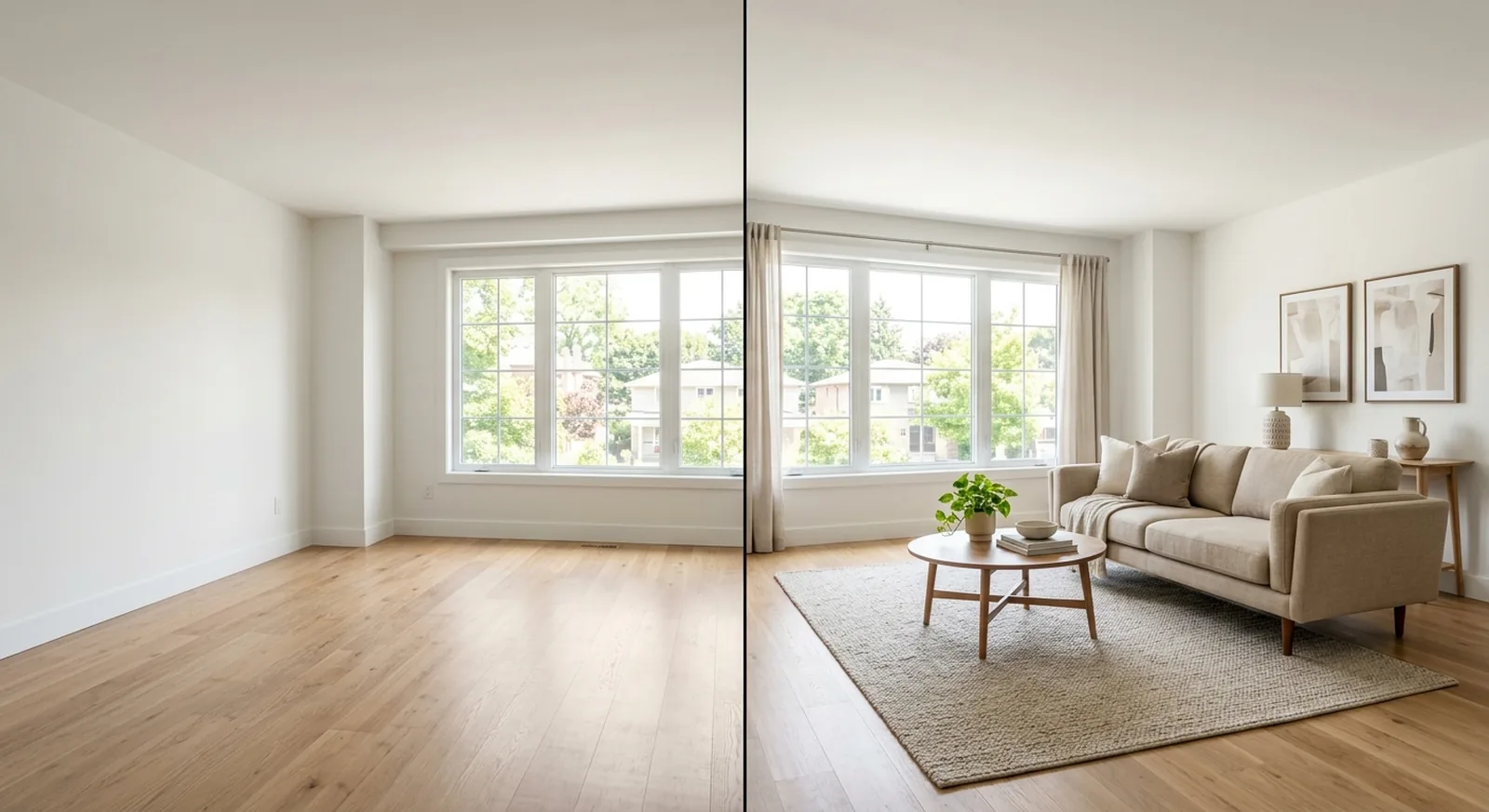

An empty three-room apartment photographs badly. Bare walls, a window with no curtain, and the eye lands straight on the vinyl flooring instead of the room. The alternative is often no better: the previous tenants moved out two days ago, and the photos still show the old wall unit, a rug nobody will miss, and a stack of moving boxes in the corner. Both sell harder than an apartment a prospective buyer can picture themselves living in at first glance.
That’s what home staging is for - and by now there’s an AI version of it that delivers in minutes what a traditional staging crew spends days carrying up the stairwell. I work with AI image editing myself on a regular basis, including for clients in real estate, and want to lay out here what actually holds up in 2026, where it comes unstuck, and why the labelling is not fine print you can forget about, especially with property photos.
What actually happens on screen
The basic principle is simple: the original photo stays the foundation. A model detects the walls, floor, and window and door lines and keeps that structure, while rendering furniture, textiles, and decor into the empty room to match the perspective, vanishing lines, and light direction already in the photo. An empty shell becomes a living room with a sofa, a rug, and pictures on the wall, without anyone setting foot inside the apartment.
The time and cost difference to traditional staging is the real reason for the boom. Physical staging means renting furniture, delivering it, setting it up, and collecting it again once the listing comes down - depending on the size of the apartment, that’s easily a mid to high three-figure sum per week, often across several weeks. Virtual staging costs a fraction of that per image and is done the same day the photos were taken. That changes who staging is worth it for at all - not just the upmarket flat, but also the unremarkable two-room apartment that a real staging crew would never have paid off for.
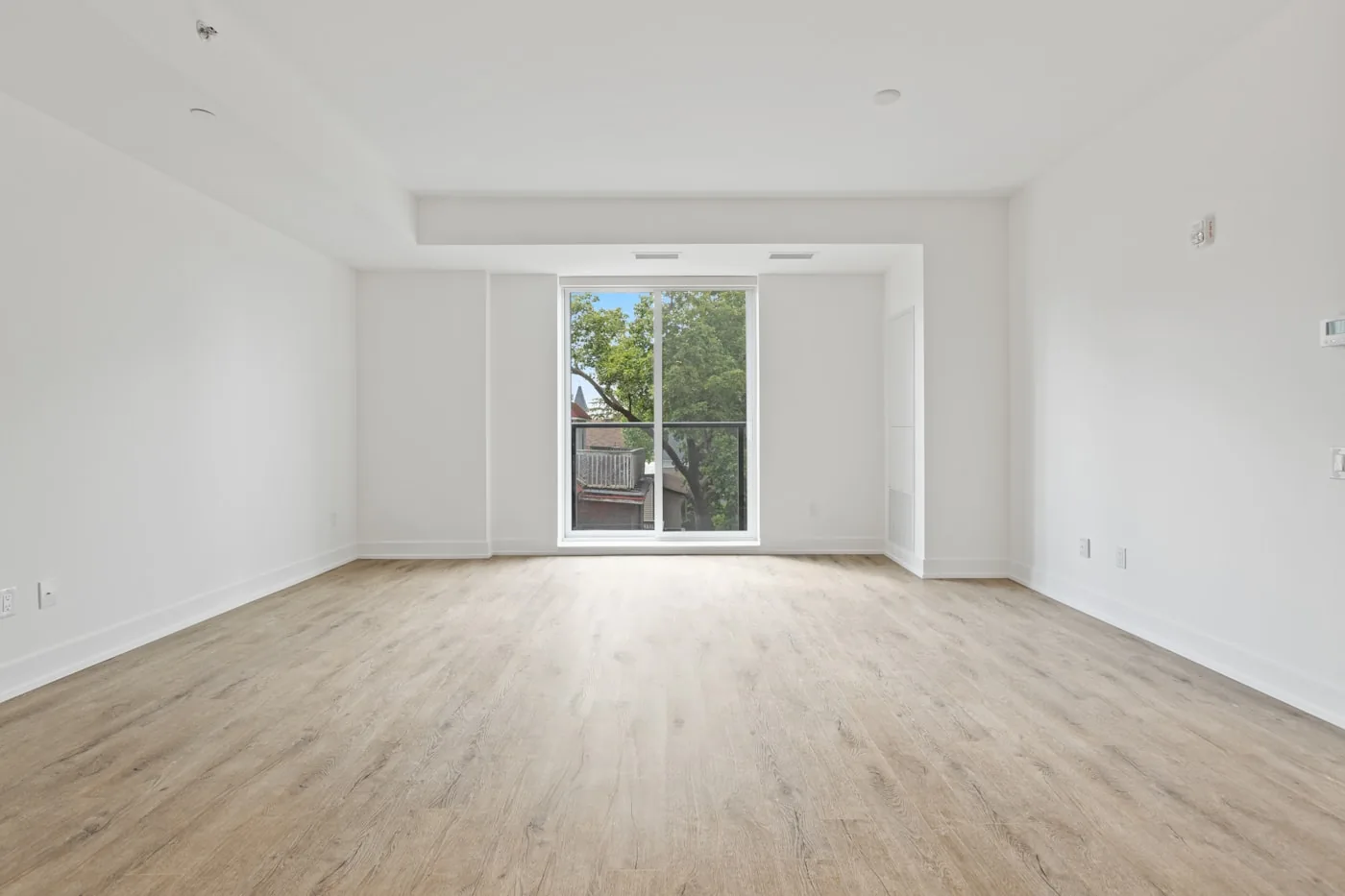 Photo: 3dottawa / Unsplash
Where it genuinely delivers in 2026
The technology works most cleanly on empty, unobstructed rooms with clean lines - the typical new-build with no previous tenant, where the walls are straight and the light falls evenly. The less in the photo already distracts from the room itself, the more reliably the new furniture sits where it belongs.
The second use case is underrated: digitally decluttering an occupied apartment. Instead of spending a whole day before the photo shoot clearing out the old wall unit and the moving boxes, the same thing can be done on screen - the existing furniture is removed and the wall or floor behind it filled in plausibly. For a rented apartment that’s still lived in, often the only realistic option at all.
And because changing the style costs only a few minutes per image, the same empty apartment can be shown in two or three furnishing styles - bright Scandinavian for a younger audience, warm and classic for a family, reduced for the upper price bracket. With physical staging that’s simply not affordable. With the AI version, it’s one more click.
The details that give it away
Where it comes unstuck usually doesn’t show up in the middle of the frame, but at the edges. Wide-angle lenses, standard for real estate photography, distort lines more than a lot of models process cleanly - a table leg kinks, a chair back curves, exactly where the original photo’s perspective was already demanding. A sofa sometimes floats a touch above the floor, with no visible contact shadow, and ends up looking pasted in rather than placed. Light and shadow are the second tell: if the window in the original photo falls from the left but the new armchair’s shadow falls to the right, every viewer notices, even without being able to name why.
The genuinely serious errors, though, sit in the architecture itself rather than in a piece of furniture. Some tools quietly correct the room while furnishing it: a window gets added where there wasn’t one, a door shifts by half a metre, a radiator disappears because the sofa placed in front of it would otherwise have looked awkward. A bent table leg is a cosmetic flaw. An invented window changes what the image actually claims about the building’s real structure - a different category of error, one that deserves checking on every finished image individually.
 Photo: minhphamdesign / Unsplash
A click-tool result, or a checked one
A web tool where you upload a photo and pick a furnishing style delivers a result in seconds, for a few euros an image, with nobody looking at it closely before or after. That’s exactly the difference a checked result makes: before an image goes out, I hold it next to the original and check that only furniture was added - no door that moved, no radiator that vanished, no window that suddenly reads a different size than it really is. Scale is the other question: a sofa that looks generous in the image but would barely fit through the door in reality leads to disappointment at the viewing that’s entirely avoidable if the room’s real dimensions stay in mind while furnishing it.
The second difference is the style itself. A click-tool tends to offer the same handful of templates regardless of whether the apartment has a low period ceiling or an open new-build floor plan. Furnishing that actually matches the room’s real height, the target buyer, and the property’s price bracket is what separates an image that looks like a catalogue page from one that looks like this particular apartment.
The disclosure duty - and the older rule that matters just as much
From 2 August 2026, Article 50 of the EU AI Act requires AI-generated or AI-altered images that resemble a real person, place, or object to be recognisable as artificially created. A virtually furnished photo of an actual apartment falls squarely within that: it’s an altered image of a real place that would otherwise look authentic without a note. The label itself doesn’t need to be loud - a small, legible note on the image or in the caption is enough, as long as a viewer can recognise it. A number of property portals already require exactly this for virtually staged photos anyway, independent of the AI Act, for the same reason: prospective buyers should know what they’re looking at before they drive out to view it.
More important than the law, though, is the rule that predates it. A prospective tenant who sees a nicely furnished apartment in the listing and finds an honestly empty one at the viewing is rarely surprised - that’s the accepted convention of staging, and as long as the label is there, nothing about it is misleading. It’s a different matter when an image doesn’t just add furniture but conceals the property’s actual condition: a crack in the wall retouched out of the picture, a room made to look larger in the photo than it is, a damp patch edited away. The moment a photo misrepresents a property’s actual condition rather than just showing a possible furnishing, it edges toward a misleading commercial practice - regardless of whether AI or traditional photo editing produced it. The line doesn’t run through the technology, it runs through whether what the image claims about the property still holds up.
If you want virtual staging done properly and labelled openly
Using virtual staging means buying two things at once: an image that convinces, and a representation that still holds up on close inspection and at the viewing. Getting both right isn’t a tool problem, it comes down to who makes the images and how closely they’re checked - in the editing itself as much as in the labelling that belongs to it from August 2026 onward.
I’m Eric Menge of EMIT Solution, a web developer who has worked with AI image editing for years - and I take on exactly this combination for estate agents and sellers: furnishing empty apartments or decluttering occupied ones on screen, checked against the original photo, in a style that fits the property, with labelling that neither hides nor reads like a warning sign. You send me the existing photos, and I take it from there remotely, wherever the apartment is.
If you want to know what that would look like for your listings: reach me at info@emit-solution.com and via emit-solution.com. The first conversation costs nothing and starts from your exposés and your listings.
FAQ
Is virtual staging the same as traditional home staging?+
No. With traditional home staging, real furniture is delivered and set up in the room, and the apartment is genuinely furnished at the viewing. With virtual staging, the room itself stays exactly as empty or cluttered as it was - only the photo shows a possible furnishing. Prospective buyers or tenants should know that before they drive out to view it, or disappointment is built in.
How can you tell a poorly done AI staging image?+
By the same details that give away other AI images: furniture with no visible contact shadow on the floor, light falling from a different direction than the window in the original photo, slightly bent table or chair legs at the edges of the frame, and repeating patterns in rugs or curtains. The most serious tell, though, is when the architecture itself has changed - a window, a door, a radiator that looked different in the original.
Do I have to label virtually staged real estate photos?+
Yes. From 2 August 2026, Article 50 of the EU AI Act requires AI-altered images that resemble a real place to be recognisable as artificially generated - a virtually furnished photo of an actual apartment falls squarely within that. A small, clearly legible note on the image or in the caption is enough; it doesn't need to be a loud warning label.
Is it a problem if the apartment looks different at the viewing than in the photo?+
Not inherently - showing an empty room furnished in a photo is an accepted convention, as long as it's labelled. It gets tricky when a photo doesn't just show a possible furnishing but conceals the property's actual condition: a crack retouched away, a room made to look larger than it is. At that point it's no longer a furnishing question but a question of misrepresenting the property itself.
Is virtual staging worth it for a single apartment, or only for larger portfolios?+
It's actually most interesting for the single apartment. Physical home staging usually only pays off from a certain price bracket upward, or across several properties at once, because delivery and setup are fixed costs. Virtual staging is priced per image, which is why it works even for the one unremarkable two-room flat that a real staging crew would never have bothered with.
Want to know more?
In a free intro call we discuss how you can use these topics for your company. Not a sales pitch, but an honest assessment.
Book a free intro call