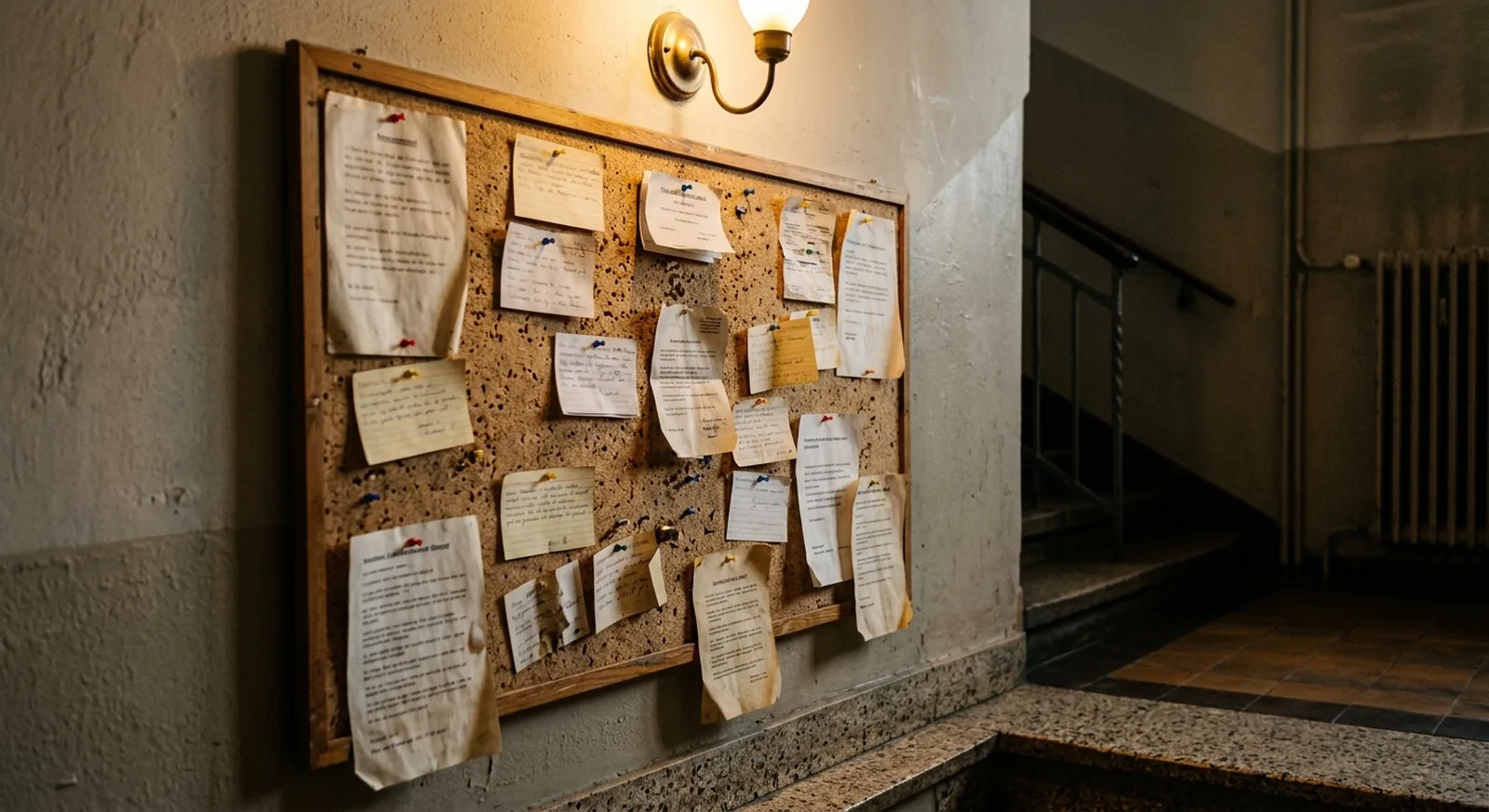

7pm, and the property manager’s phone rings again. A tenant needs the bank details to update her standing order for the rent. The IBAN is in the lease, it was on the last service charge statement, and it’s been pinned to the noticeboard in the stairwell for three weeks, ever since a change of management moved the account. And yet it gets read out over the phone for what is probably the twentieth time - because a noticeboard broadcasts information, but it has no memory a tenant can query at 7pm. This isn’t a one-off. It’s the normal case: the same handful of questions, spread across hundreds of tenants and months, still ends up as an individual phone call to the office.
A noticeboard broadcasts once, a question keeps recurring
The real problem isn’t that tenants don’t read. The real problem is that a noticeboard and a circular letter run on a logic that doesn’t match how the question actually arises. Both broadcast once, on a single date - the notice goes up, the letter goes out. The question, on the other hand, arrives on its own schedule, at a different, essentially random moment for every tenant: when the bank asks for the new IBAN, when a card from the chimney sweep suddenly turns up in the calendar, when a new job requires proof of tenancy. Between the broadcast date and that moment, months often pass.
By then, the notice has slipped from memory, the letter is buried in a folder or was never read at all because it arrived wedged between the service charge statement and junk mail. Anyone who moved in after the notice went up never saw it in the first place. And if the appointment or the contact person has changed since - which happens regularly - only the latest version is any use, and distributing that on paper means restocking forty or two hundred letterboxes for a single piece of information.
Calling isn’t laziness in that moment, it’s the only reliable option a tenant actually knows about. There simply isn’t a faster alternative to picking up the phone - a searchable place that delivers exactly this one answer in ten seconds doesn’t exist. So the real problem isn’t the enquiry itself, but that there’s no second, faster channel available besides the management company in person.
 Photo: leshatuman / Unsplash
Ten questions that account for most of the calls
For a portfolio of a few hundred units, that adds up to several such calls a day by experience, spread across a handful of recurring topics. Anyone who keeps a tally for a while quickly notices it isn’t a thousand different concerns. It’s a manageable list that keeps coming back: bank details and the deposit amount. Who’s the right contact for a water leak, a broken stairwell light or a lost key fob - caretaker, management company, or the owner. When the chimney sweep is due, when smoke detectors get checked, when the garden gets done or bulky waste gets collected. How to get proof of tenancy for a government office, a copy of the last service charge statement, or a reference for a new landlord. What the house rules actually say about quiet hours, waste sorting, or use of the basement.
For every one of these questions, the answer is identical for every tenant in the building, and it changes, if at all, only a few times a year. That’s exactly what makes it the best possible candidate for self-service: none of it needs individual judgement, it just needs to be reliably findable.
What a tenant self-service portal does differently from a noticeboard
An ordinary sub-page with a PDF of the house rules doesn’t solve the problem, it just moves the paper online. What actually changes something is how the page is organised and how it’s reached.
Organised by question, not by department: a tenant doesn’t think in case-worker categories, but in “I need the IBAN” or “when is the chimney sweep coming”. The page has to be sorted exactly that way, not by the management company’s internal structure.
No login for the non-sensitive stuff: bank details, appointments and contacts are a secret to nobody, and every hurdle in front of them only costs you usage. A light form of matching - flat number and surname - is enough even for the few things that are genuinely personal, such as a tenant’s own certificate; a full account with password management isn’t needed for that.
Reachable through a route that already exists: the most effective access point sits exactly where the notice used to hang - a QR code on that same noticeboard, a line on the service charge statement, a link in the welcome email at move-in. No new habit to learn, just a better channel at a place tenants already look.
Built for the phone, not the office screen: the question typically comes up on the sofa in the evening or right there in the stairwell in front of the notice, not at a desktop in the management office. A page that gets you to the answer in three taps on a phone actually gets used - one designed mainly for a wide office monitor sends the tenant straight back to the phone.
And centrally maintained: if the emergency contractor or the clearance date changes, one page gets updated, not a stack of letterboxes restocked. That alone turns a one-off action into something that actually gets kept up to date in practice, instead of going stale again after three months.
 Photo: magnetme / Unsplash
What self-service doesn’t replace
Two things stay a human’s job. A tenant’s own account balance, a disputed service charge statement, or an individual side agreement in the lease aren’t questions with one answer that fits everyone - no page helps there, only a conversation does. And a genuine emergency, a burst pipe in the middle of the night or a lift stuck with someone inside, still belongs on a direct line to the emergency contractor, not in a list to look up.
Self-service is deliberately built to take over only the other part: the questions whose answer is settled and identical for every tenant in the building. That’s most of the calls, but not all of them - and that’s exactly why there’s still time on the phone for the cases where someone genuinely needs to listen.
If these calls are the ones costing you your evenings
What these ten questions actually look like for you, which certificates genuinely get requested, and which route your tenants are most likely to use - that differs from one management company to the next. Which is exactly why I build this tailored rather than selling a ready-made tenant portal off the shelf: a lean page with your actual contacts, appointments and forms, one you can keep current yourself in a few minutes, without having to squeeze your operation into software built for portfolios many times your size.
If you’d like to know how much of your routine calls this could realistically take off your hands: I’m Eric Menge of EMIT Solution, reachable at info@emit-solution.com and via emit-solution.com. The first conversation costs nothing and starts from your buildings and your most frequent calls.
FAQ
Wouldn't a simple FAQ page on the existing website do the job?+
Only if it's genuinely organised around tenants' questions rather than the management company's internal structure. Most FAQ pages fail because they end up as a PDF or a wall of text nobody wants to scroll through on a phone in the stairwell. What matters is the structure: short, concrete answers to the ten questions that actually keep coming back, reachable through a link nobody has to remember.
Does every tenant have to log in separately?+
For the frequent, non-sensitive questions - bank details, contacts, appointments - no, that would just be unnecessary friction. Only for personal matters, such as a tenant's own certificate or the state of their service charge statement, does it need a light form of matching, say flat number and surname, rather than a full account with password management.
What about tenants who don't want to use a smartphone?+
For them, the noticeboard and the phone stay exactly as they are - self-service doesn't replace anything, it only intercepts part of the routine questions beforehand. Even if only some tenants start looking things up themselves, call volume drops noticeably. Not everyone has to switch over for it to pay off.
How does a page like this stay current when an appointment or contact changes?+
That's precisely the difference to a noticeboard or a letter: a change gets updated in one place, not redistributed into forty letterboxes. How easily that works day to day depends on how the page is built - a lean solution can be updated yourself in a few minutes, without needing a developer every single time.
Is this worth it for a smaller property management company with few buildings?+
It depends less on the number of buildings than on how often the same routine calls repeat. If you're giving the same answer several times a day, even a lean page with the ten most important answers pays off - it doesn't need to be a full tenant portal with complaint handling and document storage to take real pressure off.
Want to know more?
In a free intro call we discuss how you can use these topics for your company. Not a sales pitch, but an honest assessment.
Book a free intro call