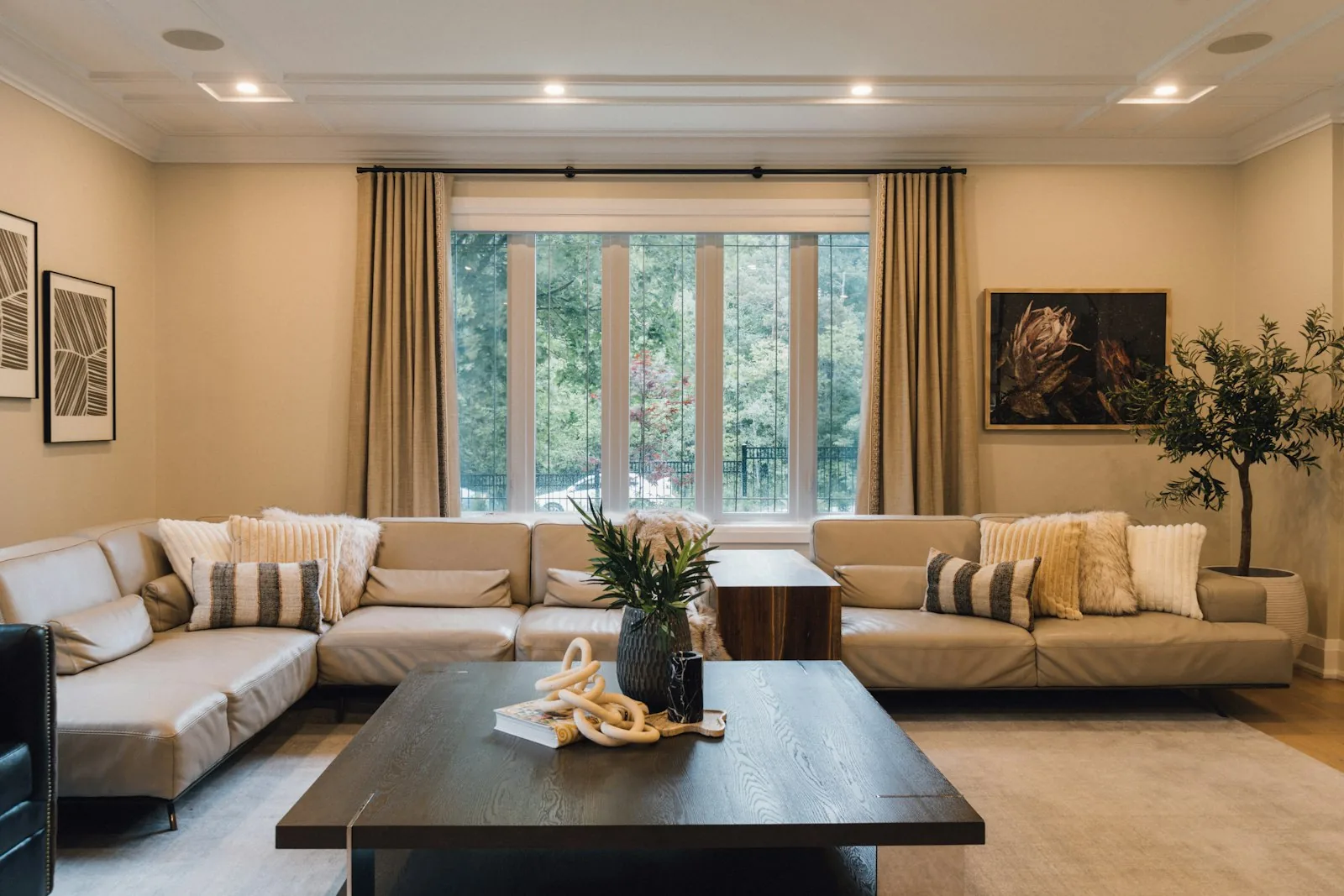

An estate agent uploads the photos of a freshly listed apartment. The living room was empty at the shoot; in the photo there’s now a sofa, a rug, a dining table by the window - virtually staged in twenty minutes, so prospective buyers can picture the space. The next photo has the grey sky over the terrace swapped for a blue one; the one after that had the previous tenant’s wardrobe removed. All standard practice, all unobtrusive. One question has only recently come up: does a note now have to say AI was used - and won’t a note like that undo the carefully prepared listing?
The short answer to both: yes, a note belongs there, and no, it doesn’t have to spoil the listing. I work with AI image editing myself on a regular basis, including for clients in real estate, and the part that worries most people is rarely the editing itself - it’s the fear that an “AI-generated” stamped across the best shot ruins the whole impression. That fear is easy to lay to rest once you know where the note belongs and what it’s allowed to look like.
Why disclosure is becoming an agent’s question now
Two things converge in the summer of 2026. First, the labelling duty under Article 50 of the EU AI Act takes effect on 2 August 2026: anyone publishing images that were artificially created or altered and that resemble a real place, person or object must disclose that they are artificially edited. A virtually furnished photo of a real apartment is exactly that - an altered image of a real place that looks authentic without a note.
Second, this is no longer a purely European matter. In mid-July 2026, New York proposed, in a report on unfair practices in the rental market, to make AI-edited photos in rental listings subject to disclosure - relying on existing consumer protection law, which already prohibits misleading commercial practices. That’s a proposal for now, not law yet, but the direction is the same as in Europe: where AI images become standard in property marketing, transparency about them becomes standard alongside.
For agents, this doesn’t mean a proven tool has suddenly become a liability. Virtual staging and AI optimisation remain exactly what they are - a fast, inexpensive way to show an apartment at its best. What I described in more detail in a separate piece on AI virtual staging still holds. The only new thing is a small ingredient that you set up cleanly once and then never have to touch again.
What actually has to be labelled on a listing photo
Not every edit is meant. Adjusting the crop, brightening an image, straightening a crooked line - that’s classic photo editing and was never an issue. The duty attaches to the use of AI, and specifically when the result still resembles a real place.
In practice, that covers four cases in a listing: virtually furnishing empty rooms, digitally decluttering occupied apartments, swapping or tidying up the sky, lawn and facade, and adding parts of the image that weren’t in the original. In all of these, you end up with an image that shows a real apartment while being partly artificially created - the core of what the AI Act wants made recognisable.
 Photo: jsnbrsc / Unsplash
The good news in this: having to label something doesn’t mean having to make it conspicuous. The law requires the use of AI to be recognisable to the viewer - not that it jump out. There’s no prescribed wording, no mandatory symbol, and no rule on size. So the real task isn’t whether you label, but where and how.
Where the note belongs - four places
For a listing, four spots suggest themselves, and they don’t compete so much as complement each other:
- The caption. On most portals and in every PDF listing, you can add a short line under or beside each image. “Interiors digitally staged” or “prepared with the help of generative AI” - matter-of-fact, legible, done. This is the most obvious and cleanest option, because the note sits right next to the image it belongs to.
- Discreetly on the image itself. A small line of text or an unobtrusive badge in a corner of the image. The decisive advantage: the note travels with the image. Property photos get passed around, pushed to several portals, shared in messages - a label that only lives in a portal’s description field is left behind the first time the photo moves on. One on the image stays put.
- In the description text. A single sentence in the property description noting that the interior shots were virtually staged. It doesn’t replace a note on the image, but it’s a good second place and answers the question before a prospective buyer asks it.
- As an info symbol on your own website. If you also show your properties on your own agency site, this is where you have the most design freedom. A small info marker in the corner of the image that reveals an explanatory sentence when tapped keeps the note recognisable and the image calm at the same time.
This last route is the one I most like to implement for clients, and I use it on this very site: the cover image of an AI-generated article carries a discreet info symbol in the top right that, when tapped, explains that it was created with AI. No red bar, no alarming tone, and still clearly recognisable. How this duty can be turned into a calm, even trust-building element is something I’ve laid out in detail in a separate piece on labelling AI content.
If I had to recommend an order: on the image itself plus a sentence in the description reliably covers the portals, because the note travels with the photo. On your own website, the info symbol is added, since it fits the design best.
What to watch on the portals
On the big property portals you have less design freedom than on your own site - a freely placeable info symbol usually isn’t an option there. That’s exactly why the note on the image and in the description field matters so much here. Some portals have required the labelling of virtually staged photos for a while already and provide a dedicated field for it; where that exists, it should be used.
 Photo: brookecagle / Unsplash
The benchmark is simple: the note has to reach the person looking at the photo - not vanish into a footer or a legal notice, where it formally meets the duty but reaches nobody. A prospective buyer who knows before the viewing that the apartment is empty and the furniture a visualisation arrives with the right expectations. In the end that’s in the agent’s interest too, because it avoids disappointment on site.
Disclosure as a trust signal, not a warning
The difference between a note that spoils a listing and one that doesn’t lies almost entirely in the wording and the placement. “AI-generated”, bold and in the middle of the image, reads like a label that sows doubt. “Interiors digitally staged”, small and matter-of-fact in the corner, carries the same information and reads like a matter of course. Both meet the duty. Only the second works for you.
One line belongs alongside it, because it’s often confused with the labelling. Showing an empty apartment furnished, or digitally tidying an occupied one, is an accepted convention as long as it’s labelled - there’s nothing misleading about it. It’s a different matter to conceal the actual condition: retouching out a crack, making a room look larger than it is, editing away a patch of damp. That’s no longer a question of AI labelling but of misrepresenting the property itself - and it applies regardless of which tool produced the image. The note labels the preparation; it doesn’t replace the diligence of making sure the image still holds true.
If you want your listing photos and labelling set up cleanly
Anyone using virtual staging and AI optimisation in a listing is really buying two things at once: images that convince, and a representation that still holds up on close inspection and at the viewing. From August 2026, labelling is part of that second half - and, placed well, it’s no burden on the listing but a detail that shows diligence.
I’m Eric Menge of EMIT Solution, a web developer who has worked with AI image editing for years. I take on both for agents and sellers from one hand: furnishing empty apartments or decluttering occupied ones on screen, checked against the original photo, and the labelling that neither hides nor reads like a warning sign - on the image for the portals and as a quiet info symbol for your own website. You send me the existing photos, and I take it from there remotely, wherever the property is.
If you want to know what that would look like for your listings: reach me at info@emit-solution.com and via emit-solution.com. The first conversation costs nothing and starts from your listings and your properties.
FAQ
Do I have to label virtually staged or AI-optimised listing photos?+
From 2 August 2026, yes. Article 50 of the EU AI Act requires AI-generated or AI-altered images that resemble a real place to be recognisable as artificially created. A virtually furnished or digitally decluttered photo of a real apartment falls squarely within that. A small, clearly legible note on the image or in the caption is enough.
Where does the AI note belong in a listing?+
There are four sensible places: the caption on the portal, a discreet line of text or small badge in the corner of the image, a sentence in the property description, and - on your own website - a quiet info symbol that reveals the note when tapped. The most reliable is a note that sits on the image itself and travels with it when the photo is shared or pushed to another portal.
Will the note spoil my listing?+
Only if you style it like a warning. The EU AI Act prescribes neither a loud label nor a warning colour. A small, matter-of-fact note - something like 'interiors digitally staged' - meets the duty without devaluing the image, and on close inspection reads more like diligence than a flaw.
Does it apply if I only replace the sky or adjust the lighting?+
Once a photo is altered with AI in a way that still resembles a real place - a swapped sky, an added lawn, a wardrobe retouched out - the duty applies. Classic brightening, cropping or straightening without generative AI is not an issue. Where the line runs in an individual case is not always sharp; when in doubt, the small note is the simpler route.
Want to know more?
In a free intro call we discuss how you can use these topics for your company. Not a sales pitch, but an honest assessment.
Book a free intro call